Actually, after spending years around the aftermarket display industry, the bigger problem is usually the opposite:
Buying screens that are too cheap without understanding why they are cheap.
At first, the pricing can look very attractive.
Especially in the iPhone replacement screen market, some suppliers offer prices that seem almost impossible compared to others selling the "same" product.
And that's exactly where many problems begin.
Because in the mobile phone display industry, two screens can look nearly identical during a five-minute test while having completely different long-term performance.
That difference is what separates stable suppliers from suppliers that create constant warranty problems.
A Lot of New Buyers Focus Too Much on Sample Quality
This happens all the time.
A supplier sends:
- one beautiful sample
- high brightness
- smooth touch
- attractive packaging
Everything looks excellent.
The buyer feels confident and places a large bulk order.
Then the second shipment arrives.
Suddenly:
- touch sensitivity changes
- frame fitting becomes inconsistent
- brightness looks weaker
- flex cables feel thinner
- return rates begin increasing
This is one of the biggest problems in the aftermarket LCD and OLED market today:
Sample quality does not always represent long-term production consistency.
Experienced wholesalers already know this.
That's why they rarely judge suppliers from one sample alone.
The Real Problem Usually Starts at the Production Line
Many people outside the industry assume mobile phone screens are produced under highly standardized systems.
That's true for original manufacturers.
But in the aftermarket industry, production quality can vary a lot between factories.
Even factories producing the same iPhone LCD screen can use:
- different driver ICs
- different backlight materials
- different polarizers
- different flex cable suppliers
- different lamination equipment
And these differences affect much more than appearance.
They affect:
- stability
- touch response
- heat resistance
- lifespan
- failure rate
This is why experienced buyers spend far more time evaluating factory consistency than simply comparing prices.
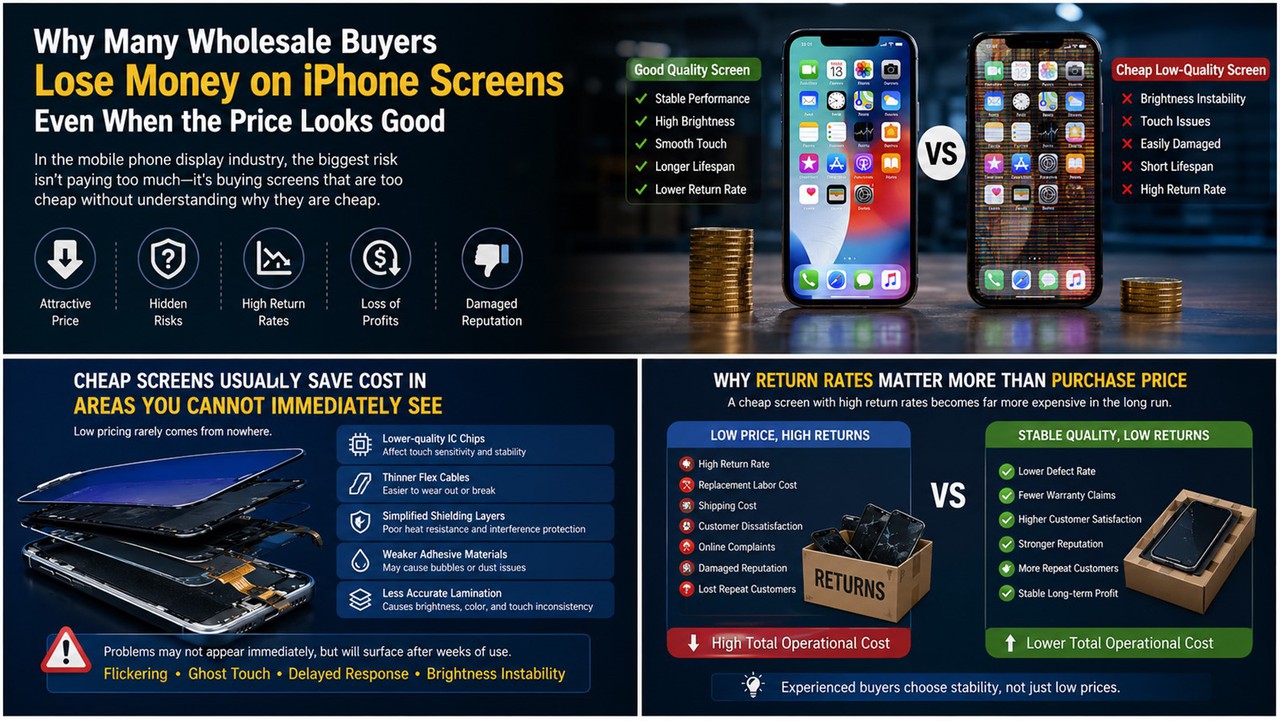
Cheap Screens Usually Save Cost in Areas You Cannot Immediately See
This is probably one of the most important things newer buyers eventually learn.
Low pricing rarely comes from nowhere.
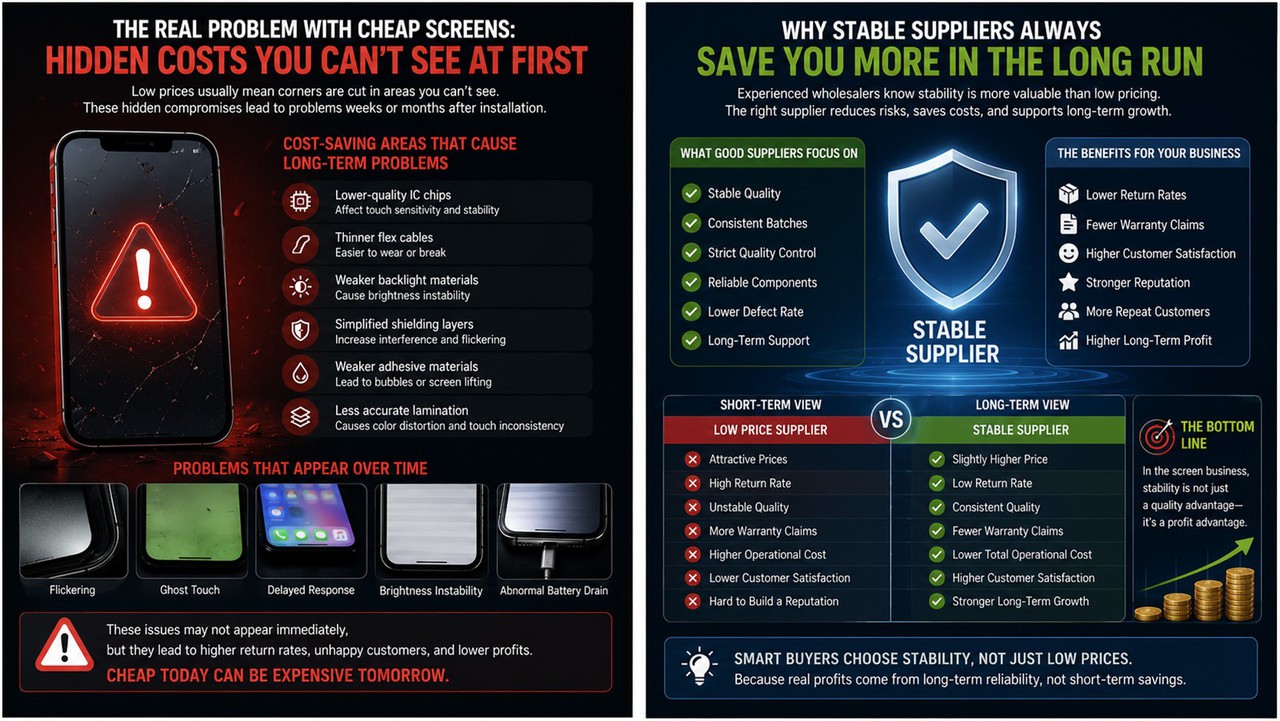
Factories usually reduce costs by changing components that are difficult to notice during short-term testing.
For example:
- lower-quality touch IC chips
- thinner flex cable materials
- simplified shielding layers
- weaker adhesive materials
- less accurate lamination
The screen may still function perfectly at first.
But after:
- heat exposure
- repeated charging
- pocket pressure
- daily touch usage
small weaknesses begin turning into real problems.
This is why some screens develop:
- flickering
- ghost touch
- delayed response
- brightness instability
weeks after installation instead of immediately.
OLED Screens Usually Reveal Problems Faster Than LCD Screens
This is something many repair shops quietly discuss now.
Low-quality OLED screens tend to expose weaknesses more aggressively than LCD screens.
Especially under:
- gaming heat
- high brightness
- fast charging
- outdoor usage
Some aftermarket OLED assemblies become unstable surprisingly quickly.
Common problems include:
- green tint at low brightness
- flickering during dimming
- touch drift
- uneven brightness
- abnormal battery drain
Meanwhile, stable high-quality LCD screens often create fewer long-term complaints in budget repair markets.
That's one reason many repair stores still actively recommend premium LCD replacements for certain customers.
Especially customers who prioritize reliability over display perfection.
Why Return Rates Matter More Than Purchase Price?
A lot of newer wholesalers focus mainly on buying cheaper inventory.
But experienced distributors usually calculate something different:
Total operational cost.
Because a cheap screen that creates warranty claims often becomes far more expensive later.
One failed installation can create:
- replacement labor cost
- shipping cost
- customer dissatisfaction
- online complaints
- damaged reputation
And once return rates increase, profit margins disappear very fast.
This is why serious repair chains usually prefer suppliers with:
- stable quality
- lower defect rate
- consistent batches
- reliable QC systems
even if prices are slightly higher.
One of the Biggest Industry Problems Right Now Is Batch Instability
This issue has become much more common recently.
Some suppliers provide excellent first batches.
But later shipments suddenly change in quality.
For example:
- touch becomes less responsive
- brightness calibration changes
- connector alignment becomes inconsistent
- frame dimensions slightly shift
To customers, these differences may seem small.
But for repair technicians installing dozens of screens every week, small inconsistencies become major operational headaches.
This is why professional buyers increasingly test:
- multiple batches
- repeated orders
- long-term installations
before building long-term supplier relationships.
The Meaning of "OEM Quality" Has Become Very Blurry
Almost every supplier today advertises:
- OEM quality
- original quality
- factory quality
- premium quality
But honestly, these labels often mean very different things depending on the factory.
There is no universal aftermarket standard.
Some suppliers genuinely maintain strict quality systems.
Others mainly focus on attractive marketing language.
That's why experienced buyers no longer trust product descriptions alone.
Instead, they evaluate:
- long-term stability
- consistency between shipments
- real-world return rates
- touch reliability
- brightness performance over time
Repair Shops Are Becoming Much More Selective About Suppliers
A few years ago, price competition dominated almost everything.
Now many repair businesses are changing priorities.
Because customer expectations are higher today.
People notice:
- touch smoothness
- brightness consistency
- battery behavior
- display stability
much faster than before.
One bad repair experience can quickly spread through:
- Google reviews
- local communities
- social media
- repeat customer networks
That's why many repair shops now care more about:
- stable inventory
- lower return rates
- consistent installation quality
than simply chasing the absolute lowest screen price.
Experienced Buyers Usually Test More Than Just Display Quality
One interesting thing about professional buyers is that they often pay attention to details many people ignore.
For example:
Heat behavior
Some screens become unstable only after extended high temperature usage.
Flex cable durability
Low-quality flex materials may fail gradually after repeated pressure.
Connector precision
Tiny alignment differences can affect installation consistency.
Brightness transition smoothness
Poor calibration often becomes noticeable at lower brightness levels.
Long-term touch accuracy
Some screens slowly develop latency issues after repeated use.
The Industry Is Quietly Moving Toward Stability Instead of Cheap Pricing
This shift is becoming increasingly clear.
The mobile phone LCD and OLED market is slowly dividing into two categories:
Low-price competition market
Focused mainly on:
- aggressive pricing
- fast inventory movement
- short-term sales
Stability-focused market
Focused mainly on:
- consistent quality
- lower failure rates
- stable long-term cooperation
- operational reliability
Interestingly, more professional repair businesses are gradually moving toward the second group.
Because stable products usually create stronger long-term business growth.
Final Thoughts
In the mobile phone screen industry, the biggest difference between suppliers is often not visible during the first inspection.
The real difference usually appears later:
- after weeks of customer usage
- after repeated charging cycles
- after heat exposure
- after daily pressure and movement
That's why experienced buyers no longer focus only on:
- low pricing
- attractive samples
- marketing descriptions
Instead, they pay much closer attention to:
- production consistency
- quality control systems
- long-term stability
- real defect rates
- supplier reliability
Because in today's repair market, stability has quietly become more valuable than cheap pricing.
And honestly, that trend will probably continue for a long time.